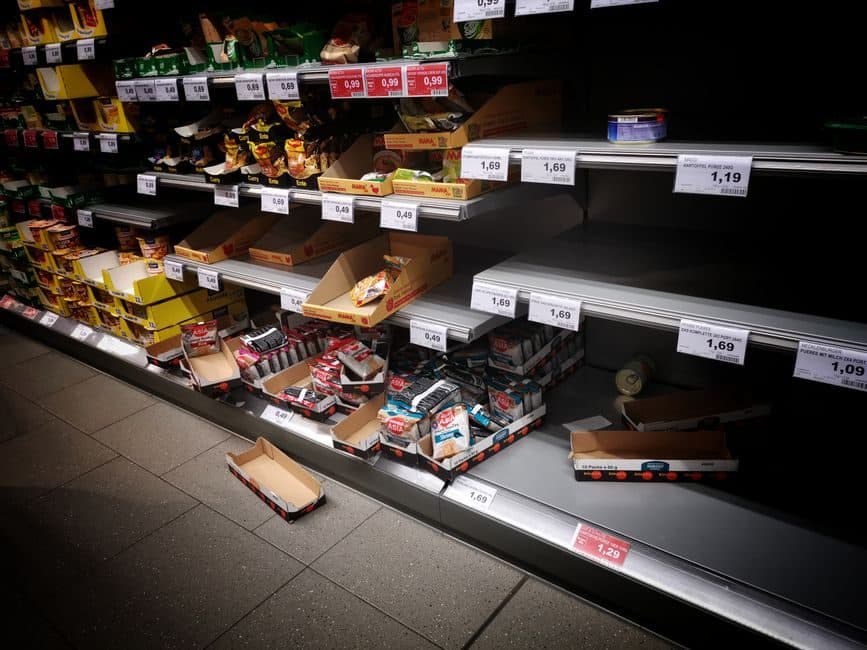
Every retailer lives with the same tension: too much inventory locks up working capital, and too little means lost sales and annoyed customers. Getting the balance right is one of the hardest problems in retail, and traditional approaches built on historical averages and gut instinct get it wrong constantly.
AI changes the equation by analysing demand patterns, external factors, and customer behaviour from your CRM to predict what you'll need, where you'll need it, and when, with accuracy that manual planning can't touch.
The Cost of Getting It Wrong
Stockouts cost retailers roughly 4% of annual revenue globally. For an Indian retailer doing ₹10 crore a year, that's ₹40 lakh in lost sales from items customers wanted but couldn't find. Worse, about 30% of shoppers who hit a stockout switch to a competitor permanently.
Overstock hurts just as much. Excess inventory ties up capital you could invest in growth. Perishables expire. Fashion goes out of season. Electronics become obsolete. Storage costs pile up. And eventually, the surplus gets cleared at deep discounts that destroy margins.
In our experience, Indian retailers typically carry 15-25% more inventory than they need because they're scared of stockouts. That fear has a real cost — and AI can quantify it.
How AI Predicts Demand Differently
Traditional forecasting looks at last year's sales for each product and adjusts up or down based on a general growth assumption. It's backward-looking and assumes the future will mirror the past.
AI forecasting pulls in dozens of variables at once:
Historical sales data: not just total units, but patterns by day of week, time of month, and season, plus how products relate to each other in buying behaviour.
External factors: weather forecasts (umbrella demand spikes before monsoon), festival calendars (Diwali drives specific category surges), local events (IPL matches boosting snack and beverage sales in host cities like Bengaluru and Chennai), school schedules affecting uniform demand.
CRM customer data: this is where CRM integration creates a genuine edge. Your CRM knows which customers buy which products and how often. It knows which accounts are showing increased engagement, signalling an upcoming large order. It knows which B2B customers have seasonal patterns. It knows when key accounts are expanding or contracting.
Competitor and market signals: pricing changes by competitors, new product launches in your category, social-media trends pointing to emerging demand.
By processing all of this simultaneously, AI generates forecasts that are typically 30-50% more accurate than traditional methods.
Practical Applications for Indian Retailers
Festival Season Planning
Diwali is the biggest inventory challenge in Indian retail. Demand for electronics, home decor, gifts, sweets, and clothing can surge 3-5x. Order too early and you tie up capital for months. Order too late and suppliers can't fulfil.
AI analyses your historical Diwali patterns, this year's pre-festival browsing and inquiry data from CRM, supplier lead times per category, and competitor activity. It generates week-by-week forecasts for the entire festival window with recommendations on when to place each supplier order.
A home-decor retailer in Surat we worked with used AI-driven Diwali planning last year and cut leftover seasonal stock by 35% while actually increasing sales by 12%. They had the right products in the right quantities instead of over-buying across the board.
Multi-Location Optimisation
If you run multiple stores or warehouses, AI figures out not just total inventory needs but where to position stock. A product that flies off the shelves in Koramangala might barely move in Whitefield. AI spots location-specific demand patterns and recommends inter-store transfers before stockouts happen.
Perishable Goods
For grocers, bakeries, restaurants, and food-delivery businesses, waste directly destroys margin. AI predicts daily demand for perishable items and adjusts order quantities to minimise both stockouts and expiry waste. Some implementations have cut food waste by 20-30% while also reducing out-of-stock incidents.
CRM Integration: The Missing Piece
Most inventory systems operate in a silo, disconnected from customer data. AI inventory management wired into your CRM is fundamentally more powerful because it sees the complete picture.
Your CRM shows a key B2B customer placing increasingly larger monthly orders. Without that signal, your inventory system has no idea the trend will continue and might understock. With it, AI adjusts procurement upward.
Marketing is planning a big email campaign next week promoting a specific product line. Without CRM data, inventory doesn't know a demand spike is coming. With it, AI pre-positions additional stock.
Several major accounts have gone quiet (engagement declining, fewer orders). Without CRM context, inventory planning assumes they'll keep ordering at historical rates. With it, AI dials down forecasts and avoids overstock.
Implementation for Indian Retail
Month 1: Connect POS data, CRM customer data, and current inventory levels into one system. Clean at least 12 months of history to capture seasonal patterns.
Month 2: Turn on AI forecasting for your top 50 products by volume (they typically represent 80% of revenue). Run AI alongside your traditional planning for a month without changing actual orders. Compare.
Month 3: Start adjusting procurement based on AI recommendations for top products. Monitor stockout rates and overstock weekly.
Months 4-6: Expand to the full catalogue. Add festival planning. Implement automated reorder triggers based on AI predictions instead of static reorder points.
Measuring Results
Stockout reduction: Track how often a customer wants something that's unavailable. Target 50%+ reduction.
Inventory turnover: How many times average inventory sells and gets replaced per year. Higher is better. AI typically improves this by 15-25%.
Working-capital efficiency: Capital tied up in inventory relative to revenue. AI optimisation usually frees 10-20%.
Waste reduction: For perishables, track expired or deep-discounted units. Target 20-30% reduction.
Forecast accuracy: AI-predicted demand vs. actual at the SKU level. Target 80%+ accuracy.
Frequently Asked Questions
How much historical data does AI inventory forecasting need?
Twelve months minimum to capture seasonal patterns. If you've got 24 months, even better. Below 12 months, the model can still run but won't handle seasonality well.
Does this work for businesses with thousands of SKUs?
Yes, that's actually where AI shines most. Manually forecasting 50 products is tedious but possible. Manually forecasting 10,000 SKUs across multiple locations is practically impossible. AI scales without breaking a sweat.
What about new products with no sales history?
AI uses analogous-product matching. It finds existing products with similar characteristics (category, price point, target segment) and uses their demand curves as a starting baseline, then adjusts as real data comes in.
How does AI handle sudden demand spikes from social media or viral trends?
Modern systems can ingest social-media signals and search-trend data. They won't predict a viral moment, but they'll detect the demand shift within hours and adjust reorder recommendations far faster than a manual review cycle.
Is AI inventory management only for large retailers?
No. A single-location retailer doing ₹2-3 crore annually can see meaningful savings. The ROI scales with complexity (more locations and more SKUs mean bigger gains), but even simple setups benefit from better forecasting.
Leadify Labs connects customer relationship data with operational systems like inventory. When your CRM knows which customers are growing, which campaigns are about to launch, and which seasonal patterns are approaching, your inventory planning gets dramatically smarter. That's less capital locked in warehouses and fewer empty shelves when it matters.